Research
Among the research topics on which I have worked are the development of pharmacophore software, development of protein-ligand docking, a method to measure enzyme similarity and computational studies of ruthenium complexes. I have also worked on the development of open source software tools for chemistry.
Development of pharmacophore software
|
I am currently a Health Research Board (HRB) Postdoctoral Fellow in the Analytical and Biological Chemistry Research Facility (ABCRF) at University College Cork where I am working on open source pharmacophore software based on Open Babel. As the first stage of this work, I am developing software for systematic generation of diverse low energy conformers called Confab. |
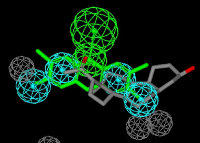
Image from Ekins et al. |
Development of Open Babel - an Open Source cheminformatics toolkit
|
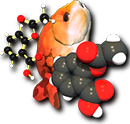
Open Babel is an international collaborative project to develop a cheminformatics toolkit which is free and open source. Any in-depth research in cheminformatics requires the ability to manipulate SMILES strings, calculate InChIs, generate 3D structures, align molecules, substructure search, calculate similarity, and so forth. The goal of Open Babel is to facilitate such research. The Open Babel project is led by Dr. Geoffrey Hutchison (University of Pittsburgh). |
Design of molecular wires with optimal properties for solar-energy conversion
|
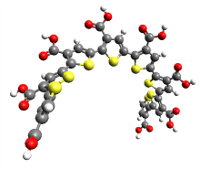
Recent developments in solar cell technology involve the use of so-called 'molecular wires' (conductive organic polymers) to absorb light in photovoltaic cells. These are very attractive due to their low cost and processability; however, the energy conversion efficiency of such systems is currently still low. In collaboration with Dr. Geoffrey Hutchison (University of Pittsburgh), I am developing a genetic algorithm that can find molecular wires whose electronic properties are optimised for solar cells. |
|
Improving the performance of protein-ligand docking software
|
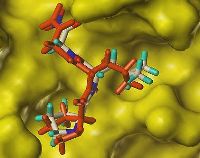
From Aug 06 to Sep 09, I was a postdoc at the Cambridge Crystallographic Data Centre (CCDC) where I worked on improving the protein-ligand docking software, GOLD. Docking software is used to rank the binding affinities of potential drugs to a particular target protein of interest. I developed improvements to the scoring function used by GOLD as part of a collaboration with Astex Therapeutics [JCIM2008]. I also investigated the underlying characteristics of scoring functions that led to success in rescoring experiments [JCIM2009]. |
A method to measure the similarity of reaction mechanisms
|
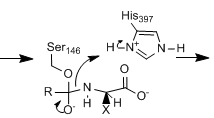
From Jun 05 to Jul 06, I was a postdoc in the group of Dr. John Mitchell who was then based in the Unilever Centre for Molecular Informatics, University of Cambridge. I developed a method to to quantify the similarity between two explicit reaction mechanisms [JMB2007]. This is especially useful when comparing enzyme reaction mechanisms, as it can highlight similarities and differences outside the conventional hierarchy of the EC system (which only considers the overall reaction). This method could also be used by an experimentalist to query an existing database of mechanisms (for example, MACiE) and see whether anyone has previously found an enzyme with a mechanism like theirs. |
|
Computational analyses of Ruthenium and Osmium polypyridyl complexes
|
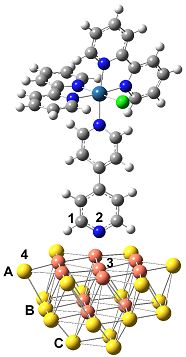
The polypyridyl complexes of ruthenium (and its neighbour, osmium) have interesting photophysical and electrochemical properties which can be tuned by suitable choice of substituents (or linking groups in dinuclear complexes). Such complexes have been proposed as components in molecular electronics, and are also of interest for the development of dye-sensitised solar cells (for light to electricity conversion). I have carried out several computational studies of novel ruthenium complexes developed in the group of Prof. Han Vos, where I have tried to throw light (pun intended) on the electronic structure that underlies experimental results. One of these studies was the first DFT (density functional theory) study of any osmium complex attached to a surface [InorgChem2007]. In that study I looked at the changes in the electronic structure of an osmium complex as it was oxidised and as it adsorbed to a surface. These results are related to in situ scanning tunnelling microscopy (STM) experiments by our collaborator (Prof. Jens Ulstrup). |