|
|
 |
|
|
VHF
This page is intended as a rough guide on how to use the VHF radio. Please note, only people who have done a VHF radio course should use the radios. This document has been drawn up so that club members will know what to do in case of an emergency.
Operation
V.H.F. means very high frequency and this equipment is designed to operate in channels i.e. Ch.16, Ch.20, Ch.12 and so on. Generally speaking V.H.F transmission is line of sight, however in good weather conditions, signals are heard over very long distances. A general rule is that the higher the aerial, the better, but normal reliable communication between small craft would be approx. 10 nautical miles maximum.
|
|
|
Equipment
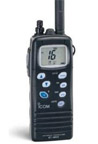 |
Hand-held V.H.F. equipment is compact and easy to use.
The main controls are:
- channel switch; which selects the required channel
- gain control; which controls the volume
- squelch control which cuts down background hiss which is peculiar to V.H.F. bands
|
|
|
|
Receiving and transmitting
 |
1.
|
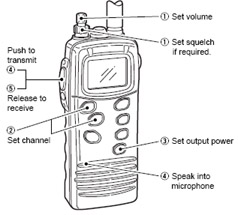
Rotate [VOL] clockwise to turn power ON, then set to the 10 o’clock position.
Turn [SQL] clockwise to mute any audio noise if necessary.
CAUTION: If the comment, "WET INSIDE", appears, turn the power OFF immediately, and contact your local dealer, or service center.
|
2.
|
Push [Y]/[Z] to select the desired channel.
When receiving a signal, "BUSY" appears and audio is emitted from the speaker.
Further adjustment of [VOL] may be necessary at this point.
|
3.
|
Push and hold [PTT] to transmit, then speak into the mic.
"TX" appears.
|
| 4. |
Release [PTT] to receive.
|
IMPORTANT: To maximize the readability of your transmitted signal (voice), pause a few sec. after pushing [PTT], hold the microphone 10 to 15 cm (4 to 6 inches) from your mouth and speak slowly at a normal voice level.
The VHF radio can be found in the dry box at the front of the club boat.
|
|
|
Working channels
When using the VHF radios, you need to know the working channels of the coastguard and which channel to use when communicating with other dive boats.
|
Channel 16:
Channel 16 is the international distress, safety and calling channel.
This is used in normal circumstances, to establish contact with another V.H.F. user. Once contact is established, both users move to another available channel, mutually agreed, leaving CH.16 free for other users.
All safety agencies monitor CH.16 so if a distress call is sent, it should be heard.
Sea Area Forecast and Gale Warning broadcasts are also announced on this channel. (Please see the weather page for more details.)
Channel 72
This is the primary channel for ship-to-ship communication between non-commercial craft. If you don't get a response from the other boat using channel 72, try calling on channel 16 and telling the other boat to switch to channel 72.
Ship-to-ship channel 8 is intended for communication between commercial craft.
|
|
|
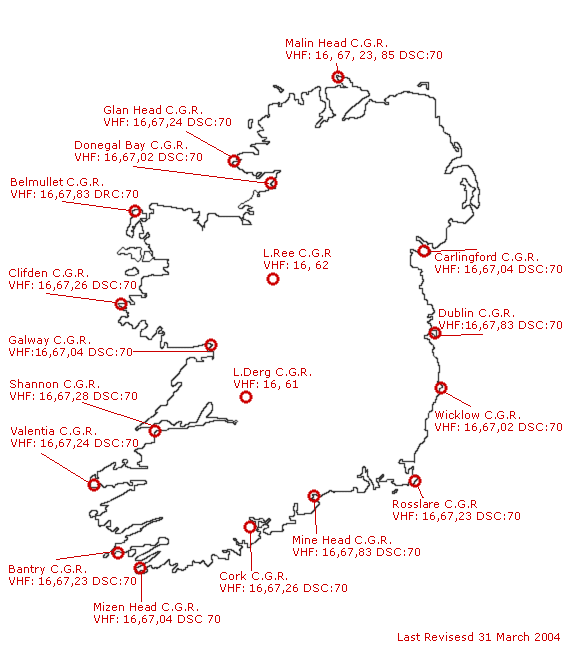
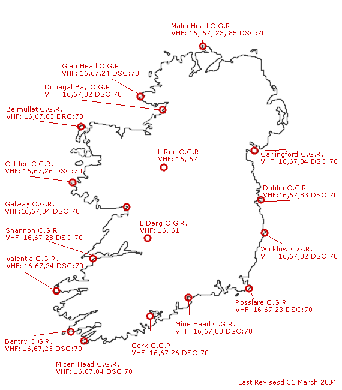
For communicating with the coastguard or listening to information provided by them, you need to know the appropriate coastguard working channel. Dublin Coastguard use channel 83 as a working channel for traffic reports and safety and weather information. For working channels for other coastguard stations around Ireland, see the map below.
|
|
|
|
Distress Calls
Safety of life at sea is of primary importance and all stations are obliged immediately to respond to distress. There are four types of distress calls.
- "Mayday, Mayday, Mayday" which means that life and limb are in imminent danger and urgent assistance is required, or vessel is in danger of sinking.
- "Pan-Pan, Pan-Pan, Pan-Pan" which means help or assistance is required but a life threatening situation is not the case.
- "Pan-Pan-Medico, Pan-Pan-Medico, Pan-Pan-Medico" which means mdeical assistance is required but a life threatening situation is not the case.
- "Securité, Securité, Securité" (pronounced Say-Cur-E-Tay) which is used to transmit a message of navigational hazard or weather conditions etc.
Procedure for Distress calls:
Call on CH.16. When contact is made,move to agreed channel to speak further. This channel should not be local station in use.
Speak slowly and clearly.
Give:
(a) Your call sign (e.g. Name of vessel).
(b) Location (include local landmarks).
(c) Nature of problem and assistance required.
(d) Number of personnel involved.
(e) Information of any location change.
Silence must be observed by all other users during transmissions.
Response to a distress call
On hearing a Mayday call on CH.16, if you are in a position to assist the problem, you are obliged by Maritime Law to do so. This law applies to all vessels at sea, from the largest to the smallest. On hearing a distress call there are a number of points to observe:
- If you are the nearest vessel, respond on CH.16 that you understand the message and are proceeding to their position.
- Alert other rescue agencies such as lifeboat, helicopter etc. and advise of the situation.
- If you are not the nearest vessel, do not clutter up Ch.16 by informing the vessel in distress that you are going to their aid if nearer vessels are assisting.
- Always leave CH.16 open as much as possible.
Silence Periods
It should be noted that all unnecessary transmissions and superfluous signals or the transmission of false or deceptive distress, safety or identification signals and of course profanity are strictly forbidden. Radio silence is observed for 3 minutes past the hour and half hour except in an emergency.
|
|
|
|
|
|
|