Emergency Proceedure
This guide is designed to give you an idea of some of what steps to take if you find yourself in an emergency situation while diving. Please be aware that no responsibility will be taken by DCU-SAC for any injury etc. caused by applying any of the proceedures on this page. This pages content may be false, or out of date.
This is not an exhaustive guide so if you are not sure about anything, ask someone on the committee or one of the more experienced members of the club for help.
Diver Accident Response:
- Bring the victim to the surface as soon and as safely as possible.
- On the surface call for emergency assistance, then check victims airway.
Start E.A.R. if required, taking care not ot flood his lungs with water entering his mouth or nose.
- Remove to boat or to shore as safely as possible, taking care that no other injuries are sustained.
- Once in the boat or on shore, the most experienced rescuer takes control of the victim.
| He/She: |
- Assesses the victim and the overall situation.
- Removes the victim to safety.
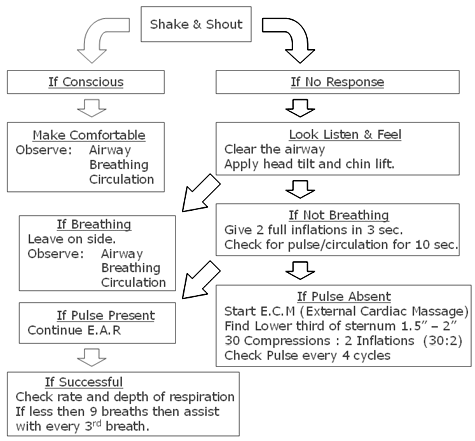
- Uses the Life Support Flow Chart to evaluate the collapsed victim.
- Checks victim's response to:-
|
Once the victim is staballised use 100% oxygen via properly fitting mask.
- Turn onto left side.
- Prevent further injury to limbs, skull and from cold..
- Reassure victim if concious.
- Consider the well being of the buddy.
- Do not move the victim unless he is stable.
- When moving to enable E.A.R / E.C.M. avoid twisting or forward movements of the head and neck.
- Transportation in a boat requires great care and attention.
- Preform recovery checks every minute.
- Do not leave the victim at any stage.
^
Appointment of Site Manager:
While the rescuer is attending to the victim a sceond person assumes control of the overall situation:-
| He/She Organises: |
- The safety of the other divers in the water.
- The safe return to shore from the dive site.
- The transport of the victim to a recompression chamber, via ambulance, helicopter (less than 1000 feet) or car.
|
| He/She Informs the Chamber of: |
- The nature of emergency.
- The number of people involved.
- The location of accident.
- The route proposed to hospital.
- The approximate time of travel.
- The medical condition of victim.
|
| He/She Records: |
- Victim & Buddys medical condition and experience.
- Depth & duration of dive.
- Rate of ascent.
- First-Aid and resuscitation methods used during in water rescue.
- When O2 administration was started and stopped.
- injuries.
|
| He/She Also: |
- Ensures that all diving equipment is not interferred with and is stored safely for analysis later.
- Checks victim's "Medical Alert Information" on log book.
|
| The Manager: |
- Travels with victim,rescuer and buddy to hospital.
- Informs relatives.
|
^
On Route (by car)
If the victims condition deteriates, stop and reassess his condition. once stabalised, proceed to hospital.
^
At the Hospital
Please inform the Casualty Doctor of the nature of the emergency and request the opinion of the Consultant Anaesthetist, as a matter of urgency.
^
Recompression Chambers Telephone Numbers
Marine Rescue |
Dial 999 and ask for Marine Rescue. |
^
Disclaimer: Advice, proceedures and information on this page may be false, misleading or out of date. No responsibility is taken by DCU-SAC or its members for any eventuality, related to any use of the information contained in this document.
|