Tide Tables
Information about the tides can be found in the Tide Tables. They predict the time of High and Low tide for each day of the year. They cover standard ports and local differences. Tide tables can be obtained from Harbour Masters Offices, Admiralty Chart Agents or Newspapers. They can also be found in the January edition of SubSea.
Chart Datum
This is a fixed level used in the measurement of depths, drying heights and the heights of tides below which the tide very rarely falls. Currently a new more accurate level is being adopted as the standard for chart Datums around the British Isles. This level is known as "Lowest Astronomical Tide" (L.A.T.). It is the lowest predictable tide under average meteorological conditions.
Rule of Twelfths
Tide Tables only give the time of high and low water, and the chart reads from chart datum, so to find the depth of water at any given time we refer to the "Rule of Twelfths". This is a rough guide to the rise and fall of a 6 hourly tide and from which it will be seen that the maximum rate of rise or fall occurs at half tide.
| 1/12th of the tidal range in the first hour |
| 2/12ths |
" |
" |
second hour |
| 3/12ths |
" |
" |
third hour |
| 3/12ths |
" |
" |
fourth hour |
| 2/12ths |
" |
" |
fifth hour |
| 1/12th |
" |
" |
sixth hour |
Worked Example:
You intend to launch your diving boat at 09.30 and land again at 10.30.
What height of tide will be available?
| High water: |
|
07.30 |
|
Height: |
|
5m above L.A.T. |
| Low water: |
|
14.03 |
|
Height: |
|
1m above L.A.T. |
Tidal range is therefore 4m
To calculate height of tide:
08.30hr - 1st hr. of fall - 1/12 of range
09.30hr - 2nd hr. of fall - 2/12 of range
So at 09.30 we have a total fall of 3/12ths or 1/4 of range of 4m, which is:
4m ÷ 4 = 1m
Height of tide at 09.30 = 5m - 1m = 4m above L.A.T.
10.30 - 3rd hour of fall - 3/12ths of range.
Total fall of 1/12 + 2/12 + 3/12 = 6/12 or 1/2 of range, which is:
4m ÷ 2 = 2m
Height of tide at 10.30 = 5m - 2m = 3m above L.A.T.
From this example you can now determine what the height of the tide will be when you want to launch and recover your boat.
|



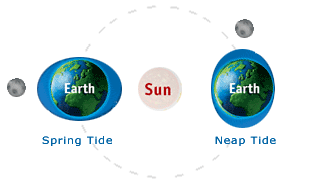 When the sun, earth and moon are in the same straight line (at new moon and full moon) the sun and moon "pull together" and then the range of tide is at its greatest. These are called "Spring tides". (i.e.) High High Waters and Low Low Waters.